
The Sea Mammal Sail Scale is a simple, intuitive way to understand different types of sailing yachts by comparing them to familiar ocean animals. Each mammal represents a distinct design philosophy:
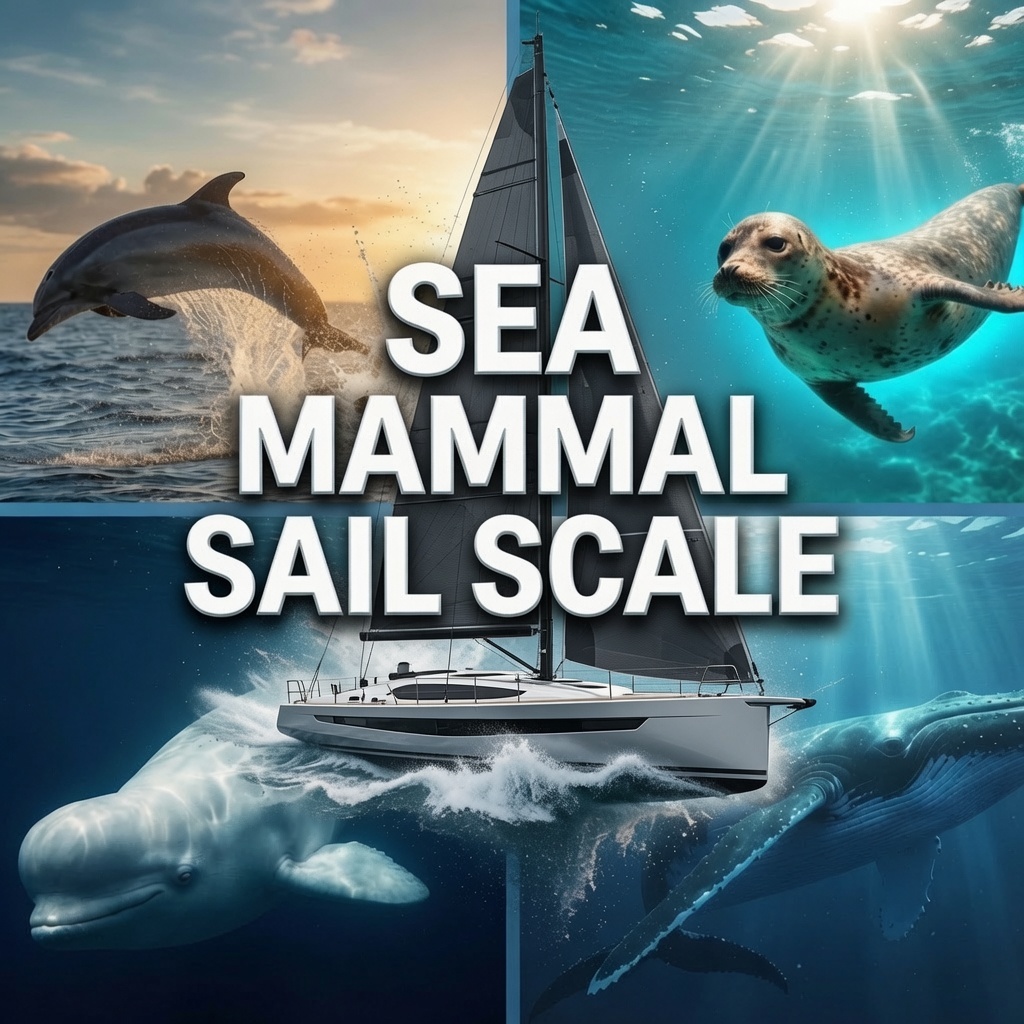
The scale doesn’t rank boats as better or worse; instead, it highlights how each type is optimised for a different purpose, helping sailors match their ambitions, cruising grounds, and comfort levels with the right kind of yacht.
NOTE: The Marine Mammal Scale is a rough-and-ready guide I made for myself to cut through the noise when looking at boats.
It only covers real ocean-capable monohulls – everything here is CE Category A (STIX 32+).
Being a Dolphin doesn’t mean you can’t cross an ocean – Pogos and J/35s have done it – it just means you’ll probably have a few more grey hairs at the end! Coastal hopping in a Blue Whale is fine too — you’ll just need a bit more wind before the sails fill!
Assess this boat [INSERT MAKE & MODEL OR URL TO BOAT LISTING HERE] using the Marine Mammal Sail Scale (https://sailinginhope.com/sea-mammal-sail-scale/).
Base your answer on real specs, preferably from sailboatdata.com. If the exact model isn’t listed there, use the closest sister-ship or reliable data from the builder, class association, or trusted reviews (Yachting Monthly, Cruising World, etc.).
Give me:
1. The animal (Dolphin / Seal / Whale / Blue Whale) and why
2. Key numbers (D/L, SA/D, STIX if known, CSF, keel type, hull material)
3. One-sentence summary of what it actually feels like on the water
| Factor | Dolphin 🐬 | Seal 🦭 | Whale 🐳 | Blue Whale 🐋 |
|---|---|---|---|---|
| Use | Coastal racing, quick passages, light offshore hops. | Coastal cruising and offshore ventures. | Bluewater cruising, long-term liveaboard. | High latitudes, heavy weather, serious ocean crossings. |
| Strength | Fast, light, fun… built for playful speed. | The versatile all-rounder that adapts to almost anything. | Steady long-distance partner for unhurried ocean miles. | An expedition-grade voyager built for the big, wild world. |
| Trade-off | Prioritises performance over heavy-weather comfort. | Prioritises flexibility. Good for a lot of things but not mastering just one. | Optimised for comfort over sporty acceleration. | Expensive! |
| Motion in 40 kt | Twitchy, surfs. | Powerful surge, forgiving. | Slow, seakindly roll. | Unstoppable freight-train roll. |
| Length Overall | 28–38 ft | 33–46 ft | 38–55 ft | 44–62 ft |
| Displacement / Length (D/L) | ≤ 170 | 171 – 220 | 221 – 280 | ≥ 281 (usually 290–380) |
| What D/L means | Light and responsive Accelerates quickly, often surfs. Typical daily run: 200–260 nm. | Well-balanced weight Good speed with comfortable motion. Typical daily run: 170–220 nm. | Heavier and very stable. Excellent motion in a seaway and strong winds. Will motor or sail slow in light winds. Typical daily run: 130–180 nm. | Very heavy for maximum stability. Maintains steady speed over long distances. Typical daily run: 140–200 nm. |
| Sail Area / Displacement (SA/D) | ≥ 21 | 18 – 22 | ≤ 18 | ≤ 18 (but huge absolute sail area) |
| What SA/D means | Powerful sail plan. Excellent performance in light to moderate wind. Reefing usually needed above 14–16 knots. | Balanced sail area. Good performance across a wide wind range. Easy to manage in 10–25 knots. | Conservative sail area. Very manageable in stronger winds. Rarely needs early reefing. | Large sails in absolute terms. Remains well-balanced even in 35+ knots. |
| Ballast / Displacement | ≥ 40 % | 34 – 40 % | 32 – 40 % | 30 – 36 % |
| What B/D means | High proportion of weight in the keel. Very stiff and upright sailing. | Good combination of keel weight and hull shape. Stiff and comfortable. | Hull form contributes significantly to stability. Reliable and steady. | Stability comes from hull design, material, and ballast. Excellent righting ability. |
| Capsize Screening Formula (CSF) A bit old school by today's design standards. | ≥ 2.00 | 1.90 – 2.00 | ≤ 1.90 | ≤ 1.75 |
| What CSF means | Suited to coastal and moderate offshore sailing. Modern designs often perform better than the number suggests. | Suitable for ocean passages. | Designed for unlimited ocean sailing. The traditional mark of a safe blue-water cruiser. | Extremely stable. Built for the most demanding high-latitude conditions. |
| Comfort Ratio (Ted Brewer) | 15 – 25 | 25 – 35 | 35 – 50 | 45 – 65+ |
| What comfort ratio means | Feels like a big dinghy. Lively, you feel every wave. | Comfortable on passage, some movement. | Very easy motion, gentle roll. | Extremely smooth, much less pitching. |
| STIX - Small Craft Stability Index | 32 – 40 | 38 – 48 | 45 – 55 | 50 – 65+ |
| What STIX means | Safe for offshore, but keeps you alert. | Solid ocean boat,. | Very stable, handles heavy weather well. | Exceptionally stable, built for the worst conditions. |
| Hull material | GRP, epoxy-plywood | GRP | Heavy GRP | Aluminium, steel, composite. |
| Steering / cockpit protection | Open, tiller or single wheel. | Twin wheels, good dodger/bimini. | Maybe centre cockpit, deep shelter. | Pilothouse or doghouse with inside helm. |
| Rudder | Single deep spade rudder, | Single spade or semi-skeg. Twin spades on more modern boats. | Almost always full skeg. At least semi-skeg. | Almost always twin spades (no skeg). |
| Keel | Deep fin keels (high-aspect, often with bulbs); Swing keels (pivoting for shallow access). | Moderate bulb fin keels; Twin keels (bilge keelers for tidal areas); Some swing keels. | Long encapsulated fins; Full/modified full keels; Scheel keels (shoal bulb on stub). | Lifting centreboards/daggerboards; Fixed centreboards (deep drop). |
| Rig | Fractional sloop (often with big overlapping genoas or code zeros). | Masthead / Fractional sloop. | Masthead cutter, masthead sloop, ketch. | Masthead cutter. |
| Tankage (fuel & water) | Weekend. | 2-3 weeks | Months | 6+ months. |
| Example boats | J/35, Olson 30, Pogo 36, J/112e | Sigma 33, First 40.7, Oceanis 40.1, Arcona 380. | Moody 425, Westerly Oceanlord, Hallberg-Rassy 40C | Older Ovni 43–48, Boréal 52, Garcia Exploration 52 |
If you're dreaming of sailing around the world solo, the first big question isn't "how?" — it's "what boat do you do it in?"
A boat is a tool and it's job it to keep you alive!
In this video, I break down my real decisions behind choosing the right boat for a solo nonstop circumnavigation. From coastal UK warm-up trips to ocean crossings and the ultimate challenge of sailing around the world non-stop, I explore exactly what the boat needs to deliver: seaworthiness, solo manageability, comfort, and enough toughness to keep me alive in the Southern Ocean.
Navigating Life's Waves—Because It's Not Always Plain Sailing
The content on this site is for informational purposes only and is not intended as medical advice. Always consult a qualified healthcare professional for medical concerns or decisions regarding your health.